

The production OS
for book publishers.
One manuscript in → every production output out — approved and connected in one title record.


The production OS for book publishers.
One manuscript in → every production output out — approved and connected in one title record.

Book production was never turned into software.
Publishing has systems of record — not a system of production. So every new title is rebuilt from scratch.
Book production was never turned into software.
Publishing has systems of record — not a system of production.
AI crossed the book-length threshold. Approval workflows made it publishable.
Book-length AI became viable
Modern models process a full manuscript as a connected whole — at negligible cost: $174 total AI spend across 444 editorial runs to date.
Approval made it professional
Raw model output was never professionally accountable. Structured approval — findings the publisher reviews, accepts or rejects — turns AI work into production an editor signs off on.
Capacity is the constraint
Six of six publishers we approached cited production capacity as the #1 constraint: output must grow without growing headcount.
The result: sequential production becomes one parallel software run — a first reviewable package in hours, not weeks, with the publisher approving every output.
AI crossed the book-length threshold. Approval made it publishable.
- 1
Book-length AI became viable
A full manuscript as a connected whole — $174 total AI spend across 444 runs
- 2
Approval made it professional
The publisher reviews, accepts or rejects every finding
- 3
Capacity is the constraint
Cited #1 by six of six publishers we approached
Sequential production becomes one parallel run — a reviewable package in hours, not weeks.
Yedioth expanded from one workflow to four — in six weeks.
Yedioth Books
“With a deep understanding of the publishing process, Seffer addressed every pain point I had encountered — from its remarkable manuscript analysis and streamlined editing process to practical guidance on marketing strategies and costs.
Using the platform felt like playing with magic. I genuinely felt I was witnessing the future of publishing.”
editorial · covers · files · channel prep
through the platform in ~6 weeks
paying since June 2026
Yedioth’s team, in-product
Yedioth expanded from one workflow to four.
“With a deep understanding of the publishing process, Seffer addressed every pain point I had encountered — from its remarkable manuscript analysis and streamlined editing process to practical guidance on marketing strategies and costs.
Using the platform felt like playing with magic. I genuinely felt I was witnessing the future of publishing.”
Next milestone: annual platform agreement — in negotiation.
A 100K-word title reached a reviewable production package in 2 hours — not 3 weeks.
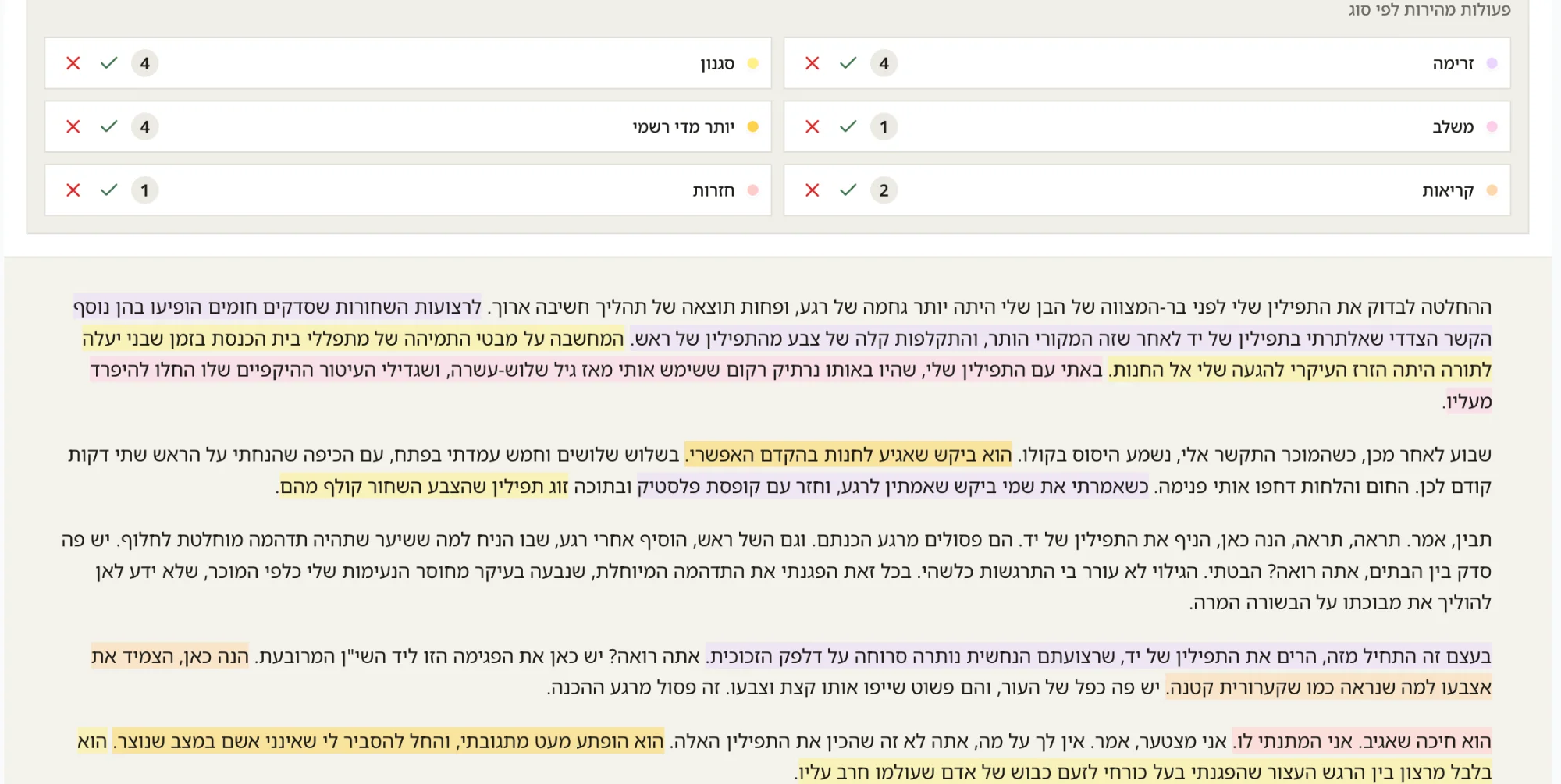
100K words → reviewable package in 2 hours.
One manuscript in.
Every production output connected.
Measured results on the previous slide · full per-function economics in the appendix.
One manuscript in. Every output connected.
- 1
Editorial intelligence
Findings → review tasks; the publisher approves
- 2
Production assets
Cover, metadata, EPUB & print-grade PDF
- 3
Channel-ready files & title data
Prepared to spec; every output stays connected in the title record
High-ACV publisher software that expands with title volume.
Future expansion: freelancer marketplace (~$1.7K avg gig · 5% take) — economics in the appendix.
Full function-by-function economics — nine functions, per-function savings — in the appendix.
Software that expands with title volume.
Base platform + per-title usage · proposed pricing.
Thousands of publishers still buy production as labor — not software.
The goal: the infrastructure through which every book is produced, approved and delivered.
Sources: AAP StatShot 2024 · 2023 US Census CBP (NAICS 51113) · UK Publishers Association · bottom-up, directional; tier counts are management estimates.
A labor market becoming a software market.
- 1
Today · software + usage
1,000 US accounts × $37–210K → $69.5M beachhead — the entry point · $200M+ with UK & EU
- 2
The position · infrastructure
revenue scales with titles produced, not seats sold
- 3
Long-term · take-rate
GMV economics on the $1–2B pool itself (marketplace · 5% take)
Land on one title. Expand across the publisher.
A ~4-week paid pilot on live titles.
Converts on measured time & cost savings.
One platform, two brands — Impria internationally · Seffer in Israel.
Founder-led sales into mid-sized independents · first dedicated US sales hire funded by this round · flagship references from live deployments.
Land on one title. Expand across the publisher.
- 1
Land
on 1–3 live titles — a real bottleneck
- 2
Prove
measured time & cost saved
- 3
Convert
to an annual platform + usage
- 4
Expand
across the whole list
1 paying · 3 active pilots (paid & unpaid mix) · 3 qualified conversations → 15–20 paying publishers. One platform, two brands: Impria internationally · Seffer in Israel.
Publishing has systems of record. It still lacks a system of production.
Systems of record exist. A system of production doesn’t.
Incumbents manage metadata around the manuscript. Impria works inside it — and produces the downstream assets.
We mapped publishing end-to-end — then built it.
Dvir Tzur
20 yrs literary editor · published author.
Yonatan Ovadia
15 yrs publishing rights & ops.

Elinadav Heymann
20 yrs programming & IT · built Impria’s production architecture, long-document AI orchestration and print-grade publishing engine — end-to-end.
Editorial craft · publishing operations · systems engineering — the three disciplines to turn book production into software.
We mapped publishing end-to-end — then built it.


The floor scenario: on $2M alone, this company cannot die.
This is the no-further-capital case — EBITDA-positive at ~month 30 with the seed alone. A Series A doesn’t rescue this plan; it accelerates the same motion: more sales capacity into the same 1,000-account beachhead and the per-title capture on the $1–2B pool.
Operating plan — expected-value scenario, not guidance. Full monthly model available in diligence.
The floor scenario: on $2M alone, this company cannot die.
Operating plan — expected-value scenario, not guidance.
36-month model runs EBITDA-positive at ~month 30 — financial plan, p. 12.
Yedioth annual agreement in negotiation. One engine, two markets.
on a SAFE — to repeatable international sales: 15–20 paying publishers · ~$1M ARR.
This round proves 15–20 paying publishers · $60–100K MRR · ~88% margin. One engine, two markets.
Nine functions publishers buy as labor. Impria runs them as software.
Verified = measured on live publisher titles · live = shipped, not yet economically measured · planned = roadmap. Savings modeled from standard US freelance / agency rates; figures vary by title length and segment. AI grounding: 444 editorial runs · 5,167 line suggestions · ~$174 total AI spend to date. Marketplace (modeled): ~900 engagements ≈ 18 publishers × ~25 titles × 2 per title · ~$1.5M GMV · 5% take. Rights & IP: AI cover output is concept material for human designer refinement — final cover art is human-designed; editorial output is suggestions a human editor accepts or rejects — the accepted edit is the publisher’s. Model dependency: AI compute is ~4% of revenue (modeled) — even a 4× provider price increase leaves gross margin ~76%.
Labor in. Software out.
Nine functions publishers buy as labor — run as software. ~90% modeled of the ~$15–30K addressable labor spend per title → ~$1.5–3K, months → days.
- 1
Production coordination
20–50 email handoffs → one connected title record · ~30 hrs → ~3 hrs, ~90%
- 2
Editorial passes
Dev · line · copyedit · proofread → one ~2-hr run · ~3 wks → 2 hrs, ~90% ($8–16K)
- 3
Cover & design
Days per revision → concepts in the title record · ~1–2 wks → hrs, ~85%
- 4
Typesetting & files
Weeks per format → EPUB + print PDF in ~10 min · ~95%
- 5
Metadata & catalog
Retyped per channel → written once, reused · ~4 hrs → mins, ~90%
- 6
Legal & contracts
Drafted from scratch → generated from choices, counsel approves · ~85%
- 7
PR & press
All PR graphics in seconds; copy & press materials prepared · ~2–4 wks → days, ~90% ($3–8K)
- 8
Distribution
Per-platform uploads → one package prepared for 20+ platforms · ~90%
- 9
Specialist sourcing
Private Rolodex → vetted freelancers in the workflow · planned
Each function becomes software revenue — and the freelancer network becomes the moat. Editorial & file outputs measured, other savings modeled from freelance / agency rates · direct distribution & specialist routing planned.
One title record becomes every sellable format.
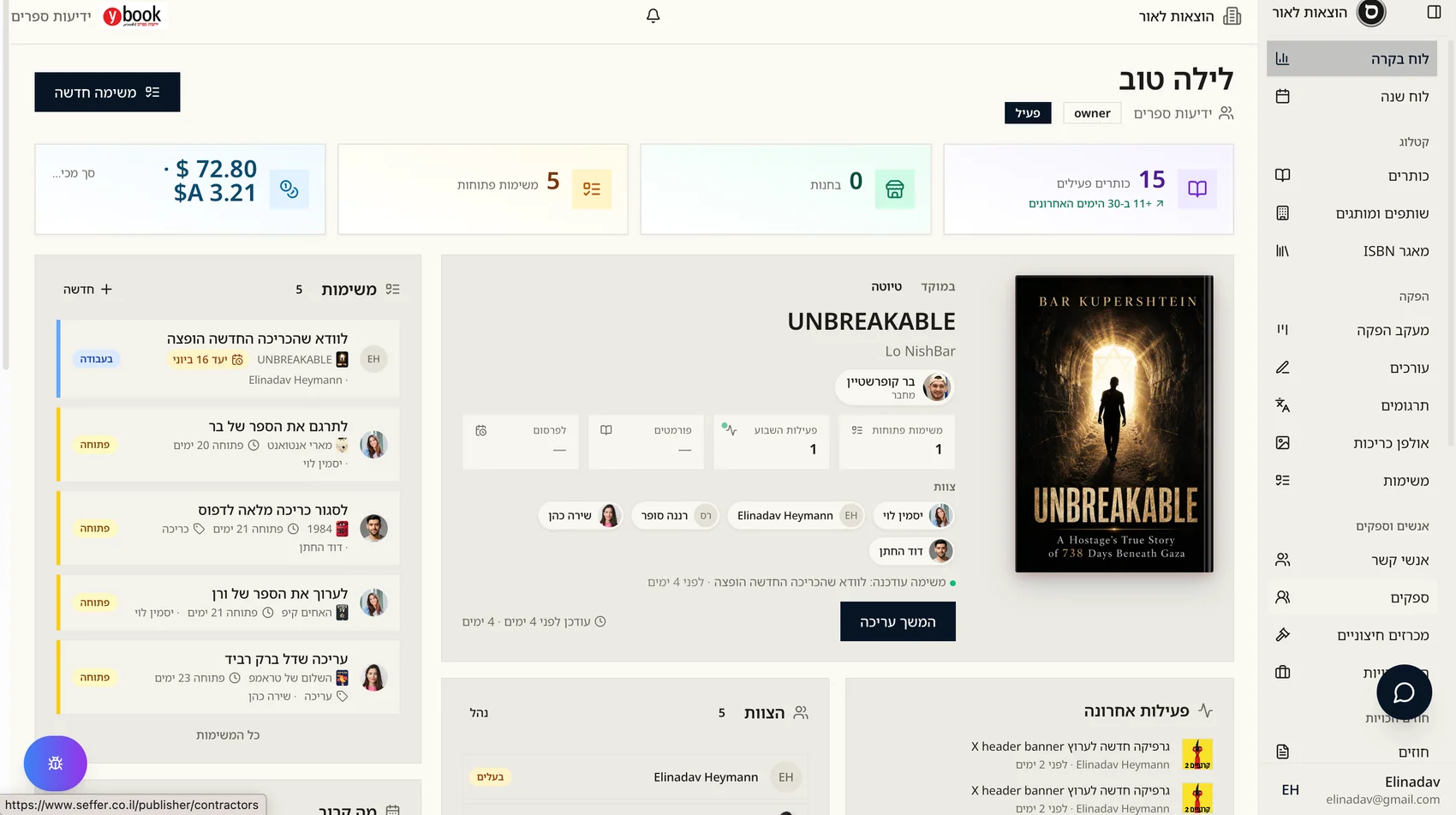


20+ platforms · 13 Amazon markets · ebook + paperback. All from one title record. Files & metadata prepared to each channel’s spec — uploads founder-assisted today; direct API distribution on the roadmap.
One title record → every sellable format.

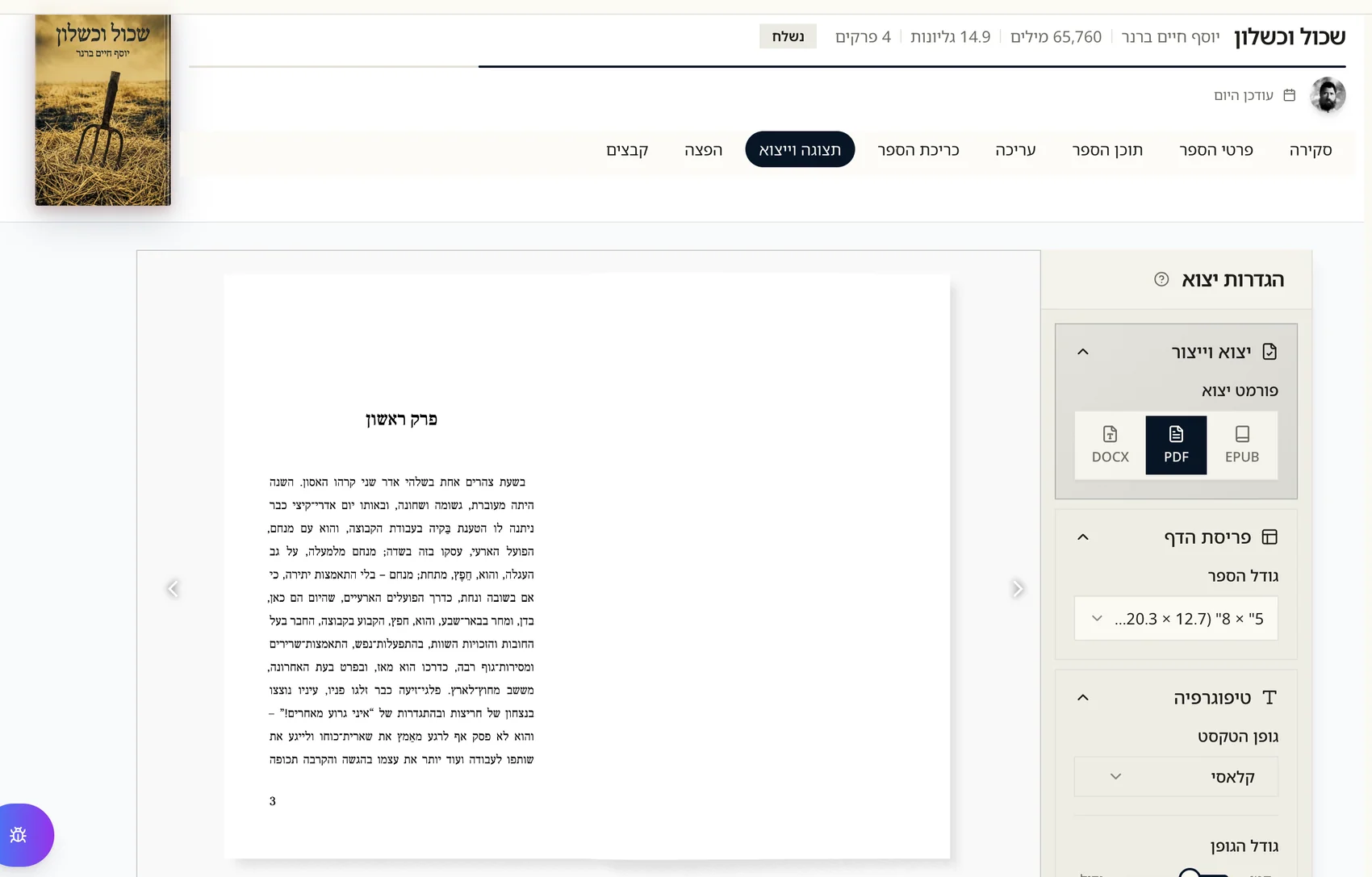
Full-Hebrew EPUB + print-ready PDF, generated in minutes.


20+ platforms · 13 Amazon markets · ebook + paperback · files prepared to spec; uploads founder-assisted today.
The $69.5M US beachhead, tier by tier.
Qualified accounts are management estimates from 2,347 US book-publisher establishments (2023 US Census CBP, NAICS 51113), excluding micro-publishers and duplicate buying entities. ACV = platform fee + per-title fee × average titles per account. Full monthly model available in diligence.
The $69.5M US beachhead, tier by tier.
- 1
Small · 600 accounts
$12K + $1,000/title × ~25 → $37K ACV · $22.2M
- 2
Medium · 300 accounts
$24K + $750/title × ~85 → $87.75K ACV · $26.3M
- 3
Large · 100 accounts
$60K + $500/title × ~300 → $210K ACV · $21M
US total: 1,000 accounts · $69.5M. From 2,347 Census establishments; UK & Europe on top.